

Chess Pieces: Base, Weight, Felt, Balance & Board Fit
Chess pieces are handled hundreds of times, so the bottom of a pawn can matter as much as the carving on a knight. Weight, base diameter, felt thickness, center of gravity and contrast decide whether a set feels stable, quiet and easy to read.
A chess piece is a small mechanical object
Weight alone does not determine feel. The base diameter, center of gravity, felt thickness and the board surface all change how a piece lifts, slides, tips and sounds.
Base diameter
This is the dimension that most directly connects pieces to square size.
Weight and balance
Compare actual mass and stability rather than relying only on weight-tier labels.
Felt and contact
A lifted felt edge can make a piece wobble, collect debris or mark a board.
04Contrast and finish
Glossy or low-contrast pieces can be tiring under overhead light even when their shapes are familiar.
Read base, weight, felt and contrast together
Chess pieces, wooden chess pieces, chess board pieces and Staunton pieces all share a job: stay recognizable, stand reliably and move comfortably. Piece height is visible, but base diameter, actual mass, center of gravity and felt condition often determine feel. The board material matters too: felt slides and sounds different on polished wood, glass, vinyl and silicone. That makes the contact layer part of the selection rather than an afterthought.
A rocking rook does not automatically need sanding. The problem may be a folded felt edge, trapped debris or a warped square. Heavy pieces are not automatically more stable either; a tall piece with a narrow base and high center of gravity can tip more easily than a lighter, broader piece.
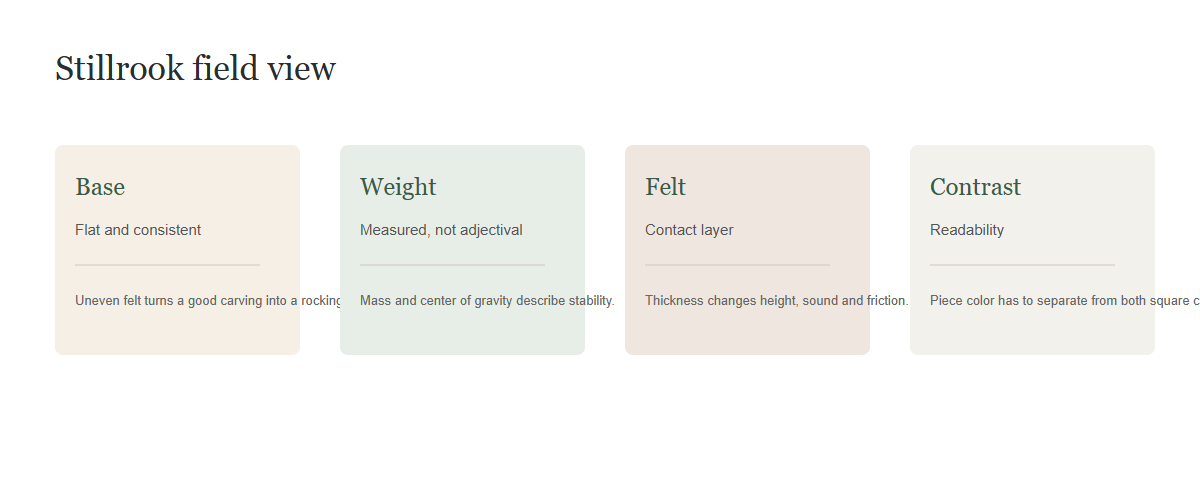
Five physical checks for a set of chess pieces
The quickest quality check is not to admire the tallest king. Put several pieces on a flat surface, move them normally and compare the details that repeat across the set.
Flat-base test
Set identical pawns on a known-flat surface. Rocking that follows one piece points to the base or felt rather than the board.
Tip test
Nudge a rook, bishop and king lightly. Stability depends on both mass and where that mass sits.
Friction test
The same felt can feel very different on wood, glass, silicone or vinyl. Match the piece underside to the board you actually use.
Light test
View the pieces under the room’s normal evening light. Separate silhouette, color contrast and surface glare.
Carry test
Extra mass improves planted feel but increases travel weight and can make collisions harsher for delicate necks and crowns.
Check the bases before judging the board
Piece quality becomes easier to judge when each symptom is tied to a physical cause. Compare several identical pawns on a known-flat surface, handle the king and rook, inspect the felt edges, and repeat the same move on more than one square before blaming the carving or the board.
Look for height and base consistency.
A gentle rotation reveals wobble without altering the piece.
A shared room may reward softer felt and moderate weight.
Warm light can reduce separation between dark pieces and dark squares.
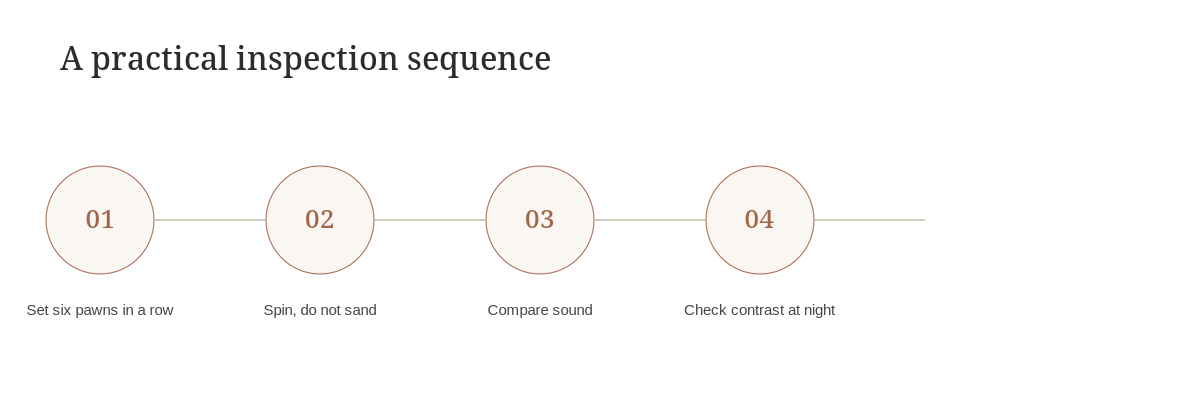
Wobble can come from the softest material
A piece that rocks may have a perfectly flat wooden base and a felt pad that is folded, contaminated with debris or glued unevenly. Inspecting the underside often reveals more than sanding the wood would.
Heavier is a trade-off
Weight can make pieces more resistant to accidental bumps, but more mass also increases impact when a piece is dropped and adds carrying weight. Tall, top-heavy pieces can still fall more easily than lighter pieces with broad bases.
The board surface changes the feel
Felt on polished wood, glass, silicone and vinyl produces different friction and sound. Replacement felt that is thicker than the original can change both piece height and stability, so repair should be treated as a matching job rather than a generic craft project.
Diagnose what the hand feels instead of calling everything “quality”
When a piece feels wrong, the symptom usually points to a physical part. A short diagnostic is more useful than a broad claim such as “premium weighted pieces.”
| Symptom | Possible causes | Simple check |
|---|---|---|
| Piece rocks | Uneven base, felt thickness, trapped debris, shifted internal weight | Rotate it on one known flat square; then inspect the felt edge |
| Piece tips too easily | Narrow base, high center of gravity, low mass | Compare with a same-height piece and use a gentle controlled tilt |
| Piece feels sticky when sliding | Rough felt, contaminated base, glossy/tacky board finish | Try several squares and compare another piece on the same path |
| Piece is hard to pick up in a crowded center | Base too large for square, neighboring pieces too wide | Measure king base and square width; recreate a dense middlegame position |
| Dark pieces disappear visually | Low color contrast, glossy reflections, busy wood grain | View from both seats under the light used at night |
“Weighted” needs numbers and balance to become comparable
Single-, double- and triple-weighted are common retail labels, but brands do not share one universal scale for those terms. A more useful listing gives actual piece or set weights, the king base diameter and enough handling information to judge stability.
Weight changes tempo
More mass can make a piece feel planted and satisfying, especially in faster play where accidental bumps matter. It also makes a travel set heavier and can increase the force of an impact if pieces collide in storage.
Center of gravity changes confidence
Two pieces with the same total weight can feel different if the internal mass sits at different heights. A lower center of gravity generally feels more planted; a top-heavy design can tip even when it sounds “heavily weighted.”
Felt is part of the mechanism
The felt is not merely decoration. It protects the board, changes sliding friction, dampens noise and can determine whether the piece sits level. Replacement felt should match thickness and diameter closely enough that the piece does not become taller on one edge or noticeably different from the rest of the set.
A felt pad made the rook nod
A Stillrook note follows a rook that rocked on every square. The carving looked straight, so the first suspicion was an uneven wooden base. Turning the rook over revealed something less dramatic: one edge of the felt had lifted and trapped a tiny speck underneath.
That diagnosis matters because a piece can wobble for several different reasons—uneven wood, off-center weight, a warped base or felt that is too thick on one side. Looking only at the carved body misses the surface that actually meets the board.
Questions about weight, wobble and feel
Chess pieces look decorative, but every move depends on simple mechanics: the base must sit flat, the weight must be controlled, the felt must stay even and the piece must fit the square.
How do I compare chess pieces that are simply labeled “weighted”?
Ask for actual mass, base diameter and preferably a piece-level reference such as king weight. “Double weighted” and similar terms are not universal standards, so they are poor cross-brand measurements by themselves.
Can chess pieces be too heavy?
Yes. More mass can improve stability but also increases impact when a piece is dropped, adds travel weight and can feel slower in rapid play. Base width and center of gravity matter alongside mass.
Why do dark pieces sometimes disappear on a wooden board at night?
Warm lighting and glossy surfaces reduce contrast in ways that studio photos may not show. Check the set under the light used for evening games and from both seats, not only from directly above.
Can a glossy chess board create visual fatigue under overhead lighting?
Yes, strong reflections can reduce square and piece contrast, especially during long games, video recording or play under bright ceiling lights. A finish that photographs beautifully may still produce glare from a seated angle. Check the board under the lighting where it will actually be used.
Why does a piece wobble even when the carving looks good?
The cause may be underneath: uneven felt, trapped debris, a base that is not flat or a board that is slightly warped. Inspect those layers before sanding or altering the piece.
How does center of gravity change stability?
A broad base and lower center of gravity resist accidental contact more effectively than mass alone. Tall, top-heavy pieces can still tip easily even when they are described as heavily weighted.
Why do the same felted chess pieces feel different on wood, glass, vinyl or silicone?
Friction, surface texture and sound change with the board material. Felt thickness and cleanliness also matter. A replacement pad can alter height and drag, so piece feel should be evaluated on the board where the set will actually be used.