
Chess Board Setup: Correct Orientation, Pieces & a Fast Fit Check
Chess board setup is usually taught as a starting position. On a physical set, setup is also the fastest inspection you will ever get: it reveals missing pieces, inconsistent felt, incorrect orientation, unclear coordinates and storage mistakes before a long game begins.
Set the board first, then the pieces
The near-right corner from each player should be a light square. Once orientation is correct, the back rank and pawns can be placed in a repeatable order and the setup becomes a useful physical check of the set.
Orient the board
Place a light square at each player’s near-right corner.
Place the back rank
Rooks in the corners, then knights, bishops, queen on her own color, and king on the remaining central square.
Add the pawns
Eight pawns fill the rank immediately in front of each side’s back rank.
Count before storing extras
A standard starting position uses 32 pieces. Extra queens are commonly supplied for promotion and should have a clear storage place.
Use setup as an eight-minute inspection
A full starting position immediately exposes missing pieces, orientation errors, crowded squares, unstable bases and confusing silhouettes. It is one of the fastest checks after opening a new set.
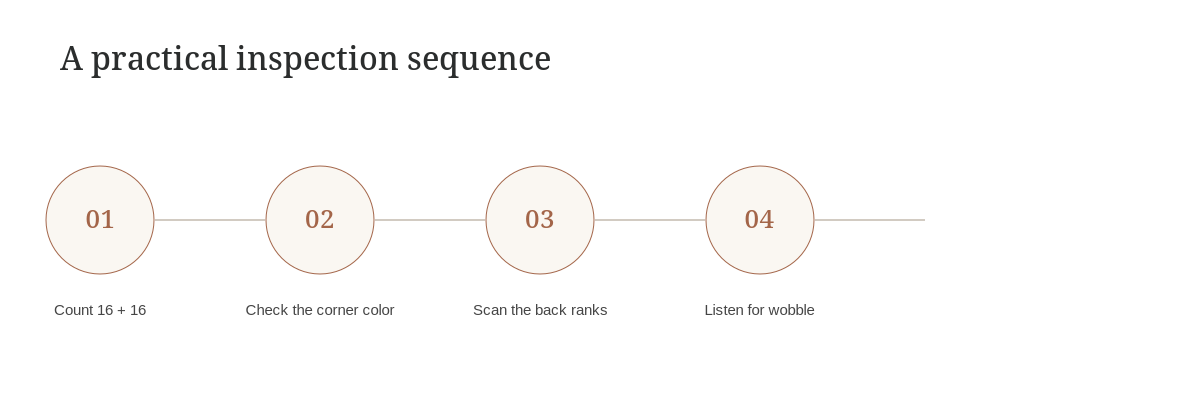
Count 16 pieces per side
Before play, confirm eight pawns plus two rooks, two knights, two bishops, one queen and one king for each color.
Check queen and king recognition
If the tops are hard to distinguish at seated distance, fast play and learning become harder even when the set is decorative.
Look at the center four squares
The starting position is spacious. Also move several major pieces toward the center to reveal whether bases feel crowded.
Use coordinates when they help
Coordinates can support notation and learning, but they are not required for a legal board. Choose them for the user, not for prestige.
Give spare queens a defined home
If two extra queens are included, storage should make it obvious that the standard starting count is still 32.
Use the starting position to inspect the physical set
Chess board setup, chess setup, chess board layout and how to set up a chess board all point to the same first-position task. On a physical set, the task can do more: sixteen pieces per side confirms inventory, the back rank reveals mismatched replacements, the corner color confirms orientation, and the act of lifting each piece exposes loose felt or wobble. Extra queens should be identified as promotion pieces instead of being mistaken for packing errors.
Coordinates are not automatically beginner decoration. They can speed notation, lessons and remote analysis. An unmarked border can still be preferable for a display-oriented home board. Setup should therefore explain orientation and inventory without turning one visual preference into a rule for every buyer.
Turn the starting position into an inspection
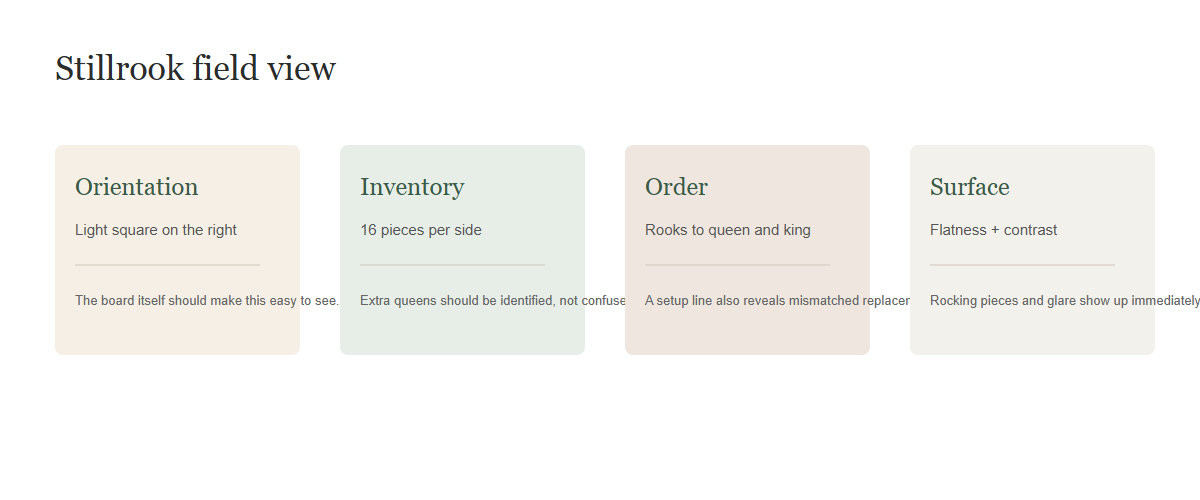
Setup is both a rules task and a physical check. Build the position from a correctly oriented board, count every piece as it is placed, and use the completed back ranks to catch a wrong-sized replacement, ambiguous silhouette or unstable base.
Then identify any extra queens separately.
A light square should be at each player’s right-hand corner.
A replacement or wrong-sized piece becomes obvious in a line.
Rocking during setup may point to felt, base or board flatness.
Setup, coordinates and extra-piece questions
A correct starting position is quick to learn, and it doubles as a useful physical inspection. Count, orientation, recognizability and extra pieces can all be checked while the board is being set up.
FIDE starting-position reference
What does a beginner really need from a physical chess set?
A beginner benefits when the starting position is easy to read: king and queen should be visually distinct, light and dark pieces should separate from both square colors, and there should be enough space to lift pieces without disturbing neighbors. Coordinates are useful when lessons or notation are part of the plan.
What do online-only players often underestimate when buying a first physical board?
Players coming from apps often know the position but not the physical routine. On a real board they must orient the corner color, recognize the queen and king by shape, count the pieces, and leave room beside the board for captured material. Setup is the first place those physical details become visible.
Are board coordinates only for beginners?
No. They can help notation, remote lessons, analysis and quick setup. Some buyers prefer a clean unmarked border for appearance, so coordinates are a use preference rather than a simple skill-level label.
When a board has a border, coordinates or drawers, what does the advertised size mean?
If the board includes a border, coordinate labels or drawers, those features do not change the starting position. They do affect where the board can sit, so treat their outside dimensions as a furniture-fit question and keep the 8×8 playing field as the setup reference.
Where should extra queens be stored?
Keep spare promotion queens outside the starting 32 pieces in a clearly separate location. A dedicated slot, small compartment or consistent position makes it obvious that they are spares and lets a new player count the starting army without confusion.
Set up the board in a sequence that catches mistakes early
The fastest reliable sequence is orientation first, then the back rank, then pawns. Starting with the board prevents a perfectly arranged army from ending up on a rotated board.
Put a light square at each player’s right-hand corner
FIDE’s Laws describe an 8×8 board of 64 alternating squares and place the board so the near right corner is white. If the coordinates are printed, this also puts White’s first rank and file labels in their expected orientation.
Build the back rank from the outside in
Rooks occupy the corners, then knights, then bishops. The two remaining center squares belong to queen and king. Put the queen on a square of her own color: light queen on the light center square, dark queen on the dark center square.
Add eight pawns in front of each army
Once the second and seventh ranks are filled, count sixteen playing pieces per side. If the box contains extra queens for promotion, keep them outside the starting position and give them a clear storage location.
Use the starting position as a whole-set inspection
Setup places every piece on the board at once, which makes it one of the quickest ways to spot a physical mismatch that is easy to miss when pieces are handled individually.
| Look at | What a normal setup can reveal | What to do if it looks wrong |
|---|---|---|
| Piece count | Missing pieces, duplicate colors or unexplained extras | Compare with the included-parts list before discarding packaging |
| Center spacing | Whether queen, king and neighboring pieces feel crowded | Measure square width and the largest base before changing the board |
| Piece identity | Whether king/queen and bishop/pawn shapes are immediately distinct | Check side-profile photos or choose a clearer piece style for learning |
| Board orientation | Whether coordinates and light/dark squares agree with the rules | Rotate the board, not the piece arrangement |
| Wobble | Whether a piece or the board surface sits unevenly | Rotate the piece and test another square to isolate the source |
Use two simple relationships instead of memorizing a photograph
The starting position becomes easier to reconstruct when the board orientation and queen placement are understood as relationships. First, each player has a light square at the near right corner. Second, each queen begins on the center square that matches her color. With those two anchors fixed, the rest of the back rank is symmetric.
Outside to inside
Place rooks in the corners, knights next to the rooks and bishops next to the knights. Only the two center squares remain, so queen-on-her-color determines the queen and the king takes the final square. This method works even on a board without printed coordinates.
Pawns form the second line
Each side places eight pawns directly in front of the back-rank pieces. Counting that row is a quick inventory check because a missing or duplicate pawn is immediately visible before the first move.
Coordinates are a reference layer
Printed files and ranks can make notation and lessons faster, but the position does not depend on having labels. If the labels seem to disagree with the corner-color rule, rotate the physical board and verify the printed orientation before moving the pieces around.
Keep promotion pieces and accessories out of the starting count
Many complete sets include extra queens, and some packages add clocks, notation materials or storage inserts. Those extras belong to the product, but they do not belong on the board at move one.
A normal starting army contains sixteen playing pieces for each side: eight pawns plus two rooks, two knights, two bishops, one queen and one king. If the box contains thirty-four pieces because it includes a spare queen for each color, give the two spares a separate location and teach the starting count as sixteen plus sixteen. This avoids a common beginner problem in which “everything in the box” is mistaken for “everything that starts on the board.”
Once the position is complete, look across both armies from the side. The rows make outliers easy to spot: a replacement pawn that is taller, a queen with a different base, a rook that leans because of its felt, or one square that makes several pieces rock. Setup therefore finishes two tasks at once—it prepares a legal starting position and gives the owner a repeatable inspection of the physical set.
A child remembered “queen on her color”
A Stillrook learning note describes a child placing the queen on the wrong square. Instead of correcting the move immediately, Jose asked the child to compare the light queen with the light square. The child stated the pattern and later reminded the adult of it during the next setup.
That is why coordinates, color contrast and clear piece shapes are functional learning features. They give a new player visual anchors. A beautiful board that makes those anchors hard to see can make the first physical games more confusing than they need to be.