

Chess Sets for Beginners: Clarity, Comfort, Safety & Room to Learn
A beginner chess set does not need to be the cheapest set, the largest set or the most decorative set. It needs to make the board readable, the pieces easy to identify and the first physical habits easy to repeat.
Clarity beats decoration when the board is still becoming familiar
Beginner chess set, chess set for beginners, beginners chess set and chess board for beginners searches deserve more than a low-price filter. A useful first set has recognizable silhouettes, readable contrast, sufficient finger room and an inventory that can be reset without confusion. Coordinates can help notation and lessons, while a storage layout can teach the routine of counting pieces. Materials can be simple; ambiguity should not be.
Skill level and physical safety are separate questions. A child may understand the rules and still be in a household where detachable small parts or magnets require different supervision. “For beginners” describes chess experience, not a complete age or safety assessment.
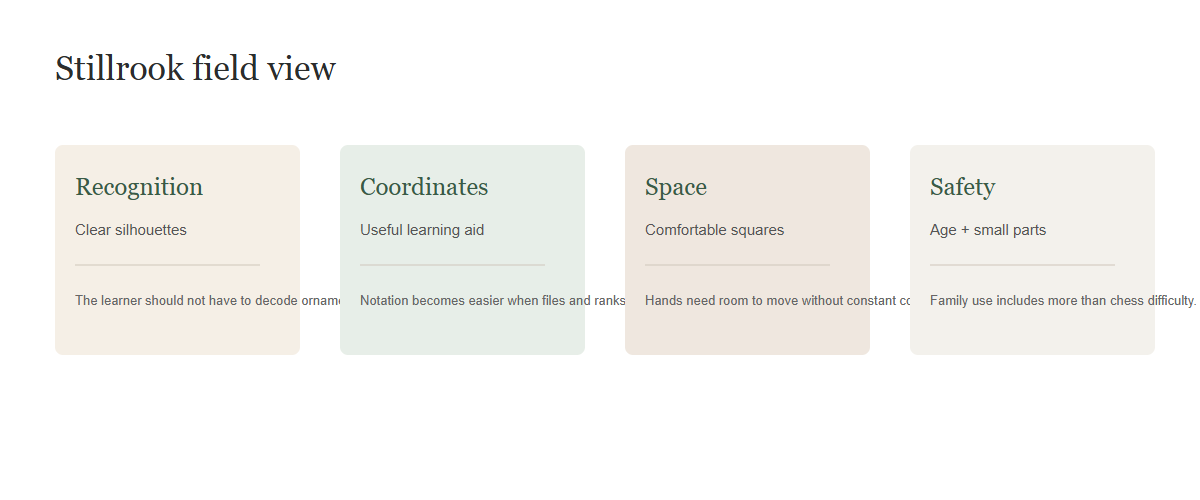
The first set should remove friction from learning
Beginners benefit more from clear shapes, comfortable spacing and an easy reset routine than from expensive material. For children, physical construction and small-part or magnet risks are separate from chess difficulty.
Clear silhouettes
Rooks, bishops, knights, queen and king should be easy to distinguish without memorizing decorative details.
02Coordinates
Letter-and-number labels can help connect a physical board to notation and online lessons.
03Comfortable scale
Pieces should be large enough to grip but not so wide that neighboring bases crowd each square.
04Safe construction
For child-accessible sets, inspect detachable parts, base closures and any magnets in addition to the age label.
What beginners need—and what they can skip
A learning set is successful when it is easy to set up, easy to read, pleasant enough to use repeatedly and simple to put away. Decorative upgrades can wait until the player knows what they value.
Prioritize recognition
Traditional, distinct piece shapes reduce cognitive overhead while the player is still learning legal moves and notation.
Use coordinates if lessons rely on notation
Coordinates are useful scaffolding for many beginners, especially when moving between apps, books and a physical board.
Do not oversize the bases
Thicker pieces can be easier for small hands, but wider bases also need wider squares. Stability and crowding must be balanced together.
Treat magnets as a construction question
A magnetic feature can be convenient, but any loose or damaged magnet is a safety issue. Inspect the base after drops or rough handling.
Buy for repeated use, not future status
A clear, durable set used four times a week is more valuable to a beginner than a premium set that stays boxed because it feels precious.
Beginner and family questions
A beginner set should make the board easier to understand, not add decorative or mechanical distractions. Size, clear shapes, coordinates and safe construction matter before luxury material.
Rules and magnet-safety references
If children’s chess pieces use wider bases for stability, should the squares grow too?
Usually the base-to-square relationship matters more than lowering the piece height. A wider base occupies more of the square and can crowd neighboring pieces even when the piece is shorter. Compare the widest bases with the square width and leave enough hand space for normal moves.
Does “for kids” automatically mean the product has been assessed for small parts and magnets?
No. Chess difficulty, small-part risk, coating requirements and magnet containment are separate questions. Family buyers should look for age-appropriate safety information that refers to the physical product, not just the game.
What should an adult inspect after a child drops, hits or chews a chess piece?
Inspect more than the visible surface: check the base, felt, seams, glued ornaments, internal rattling, exposed weights and any magnet containment. A piece with a loose internal component should be removed from use rather than handed back because the exterior still looks intact.
Should age guidance for a chess set be based only on game difficulty?
No. Learning level, choking hazards and magnet hazards are separate. A set can be easy to learn with and still contain physical components that require older users or adult supervision.
How can safety information stay with a chess set after the box is lost or the set is given away?
Durable information can live in more than one place: a label on the storage case, a product identifier on the set, and an online care-and-safety page tied to that identifier. The goal is for age and hazard information to remain discoverable even when retail packaging disappears.
What does a beginner really need from a physical chess set?
The first set needs clarity more than luxury: recognizable silhouettes, a complete starting inventory, comfortable spacing and enough color separation to read the board quickly. Coordinates can be valuable for lessons and notation, while elaborate carving or strong magnets should only be added when they solve a real use problem.
Is “for professionals and beginners” a meaningful product claim?
Only if the page explains why. Beginners may need coordinates and clear silhouettes, while experienced event players may prioritize standard proportions and specific board dimensions. One phrase should not erase those differences.
What do online-only players often underestimate when buying a first physical board?
A player trained on a screen may be surprised by how much real space a set consumes and how different pieces feel to lift. Before buying, check where captured pieces will go, whether the board reflects the room light, and whether the learner can move central pieces without bumping their neighbors.
Can players with low vision or hand tremor need different piece choices?
Yes. Higher contrast, broader bases, moderate weight and clear silhouettes can make handling and recognition easier. Accessibility can change what “best” means even when the rules of chess are identical.
Make the learning set easy to reset
A beginner set should reduce avoidable friction during the first games. Set up a full position, ask a new player to identify every piece, make several central moves and check whether coordinates, contrast and square spacing support learning instead of demanding extra explanation.
Avoid designs where bishops, queens or knights are visually ambiguous.
Check both daylight and evening light.
Especially for notation, lessons and remote coaching.
Resetting 16 pieces per side makes lost pieces easier to notice.
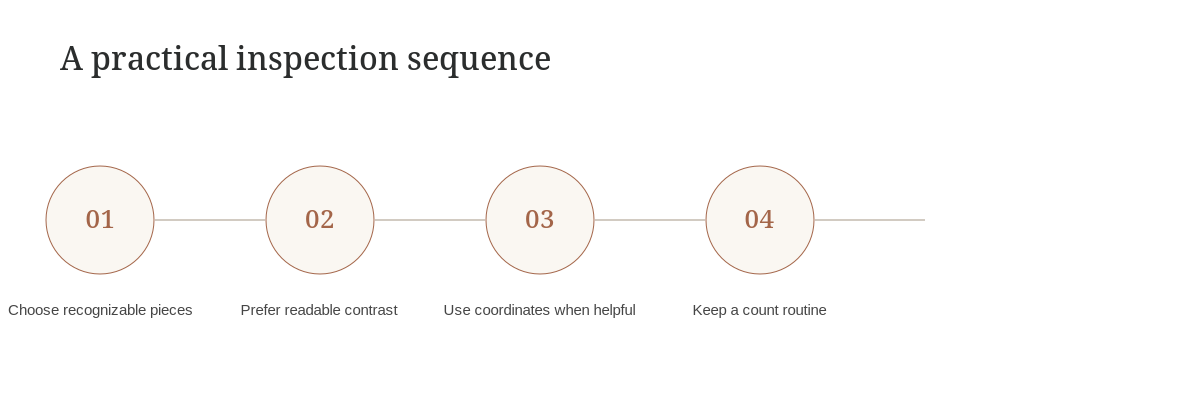
Remove four kinds of friction from a first physical set
Beginners already have rules, notation and pattern recognition to learn. The equipment should not create extra work through cramped squares, ambiguous shapes, hard-to-read colors or storage that makes pieces disappear between games.
Recognition friction
Choose conventional, clearly differentiated piece silhouettes. A highly themed set can be fun later, but a new player benefits when king, queen, bishop, knight, rook and pawn are recognizable without a second look.
Space friction
Tiny travel boards save room but can make the center difficult to manipulate. A first home set should leave enough space for fingers and captured pieces. Measure the actual squares, not only the outside board.
Learning friction
Coordinates are useful when lessons use algebraic notation or the player moves between online and physical chess. They are not mandatory for chess itself, but they can make the learning environment more consistent.
Ownership friction
Pieces should be easy to count and store. Extra queens should have an obvious location. A beginner set that is always complete and easy to reset gets used more often than one that requires a search before every game.
For children, “educational” does not replace a construction check
Age suitability depends on the actual product. Small parts, detachable components and magnets deserve special attention. A traditional magnetic chess set with enclosed magnets is different from a game made of loose high-powered magnets, but a damaged chess piece can still become a hazard if a magnet is exposed.
Check the manufacturer’s age information and current recall notices. The U.S. Consumer Product Safety Commission warns that swallowed high-powered magnets can attract inside the body and cause severe injury. For a family set, intact construction and regular damage inspection matter more than a dramatic “strong magnet” demonstration.
The teenager looked for coordinates before material
A Stillrook note follows a young player opening a physical board after learning mostly online. The first thing he checked was not the wood grain; it was the letters and numbers around the edge. Coordinates let him move between a screen, a lesson and the physical board without translating the whole position in his head.
That preference is useful when buying for a beginner. Features that reduce learning friction—clear silhouettes, readable squares, coordinates when notation is being learned and enough room to move pieces—often matter more than an expensive wood species or a highly polished finish.