
Tournament Chess Sets: Replace “Official” With Measurable Fit
Tournament chess set is a useful shopping phrase and an easy place for vague claims. The word should lead to measurable dimensions, recognizable pieces, stable bases and an explanation of where the set is intended to be used—not a suggestion of endorsement that the page cannot prove.
Tournament suitability is a list of measurable properties
A serious tournament claim should unpack into dimensions, piece recognizability, stability, contrast and surface behavior. If those facts are missing, the label cannot do the work for them.
Board squares
Current FIDE technical specifications recommend equal 5–6 cm squares for non-electronic tournament boards.
02Piece proportions
FIDE specifies Staunton-style pieces and gives standard heights plus proportion and stability guidance.
03Contrast and glare
The board and pieces should remain distinguishable under normal playing light; matte or non-reflective surfaces reduce glare.
04Club durability
Schools and clubs may value replaceability, cleanability and resistance to repeated handling over premium materials.
What a tournament-style set should let you verify
The current FIDE equipment specification is useful as a reference point, but a product should not be treated as certified merely because one dimension happens to match a range.
Square size
FIDE’s March 2026 specification states that board squares should measure 5 to 6 cm per side.
Piece height and base
The same specification gives a 95 mm standard king height and says piece bases should be about 40–50% of piece height, while maintaining proportional order.
Stability
Pieces should be balanced and stable; FIDE’s technical text includes a tilt-stability recommendation rather than a marketing weight class.
Visual recognition
Staunton style, clear light/dark contrast and immediately recognizable silhouettes matter more in fast or repeated play than ornate detail.
Use environment
A home display set, a club workhorse and an event set can share dimensions while needing very different durability and replacement support.
Replace the adjective with the dimensions
Tournament chess set, tournament chess board, regulation chess board and professional chess set are high-intent phrases, but the words are useful only when the page names the physical criteria being referenced. Square size, king height and base, piece recognizability, board contrast and stability are checkable. “Official” without an organization, rule set or dimension is not. This page keeps tournament-use selection separate from the beginner-learning page and from the broad chess-set category.
Shared club and event equipment also changes the priority order. Replaceability, clear Staunton-style silhouettes, durable surfaces and quick inventory checks matter more when many hands use the same set. A fragile decorative knight can be excellent at home and inconvenient in a club without either judgment being contradictory. Clocks, notation sheets and captured pieces also consume table space that a product photograph rarely shows. For event-oriented use, the measured board must make sense in that working area, not just meet a label in isolation. If a specific organizer publishes equipment requirements, those requirements outrank a seller’s generic use of words such as regulation or professional.
A tournament claim should unpack itself
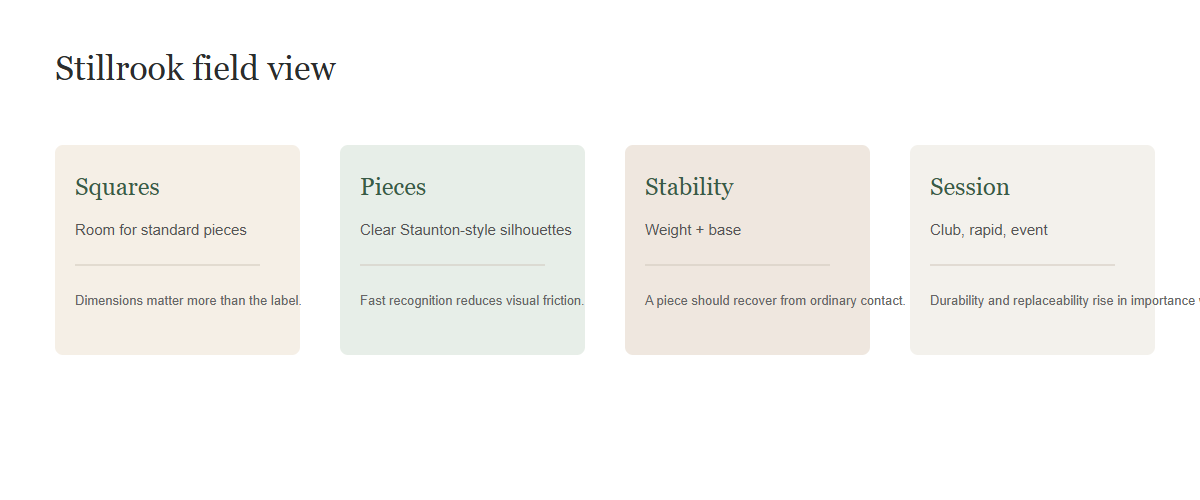
If a page uses “tournament,” it should show square size, board footprint, piece dimensions and the design family of the pieces. That lets a buyer compare the object to the requirements of the event or club they actually attend.
Club equipment lives a harder life than home display pieces
Fast time controls, repeated packing and many users reward clear silhouettes, stable bases and easy replacement. Intricate knight carving and delicate finishes may be desirable at home but can add maintenance in shared use.
Beginner and tournament are not the same promise
A beginner may benefit from coordinates, a rules card and easy-to-distinguish pieces. A tournament player may prioritize familiar proportions and board dimensions. A product can serve both, but the reasons need to be stated separately.
Hands-on checks for tournament chess sets
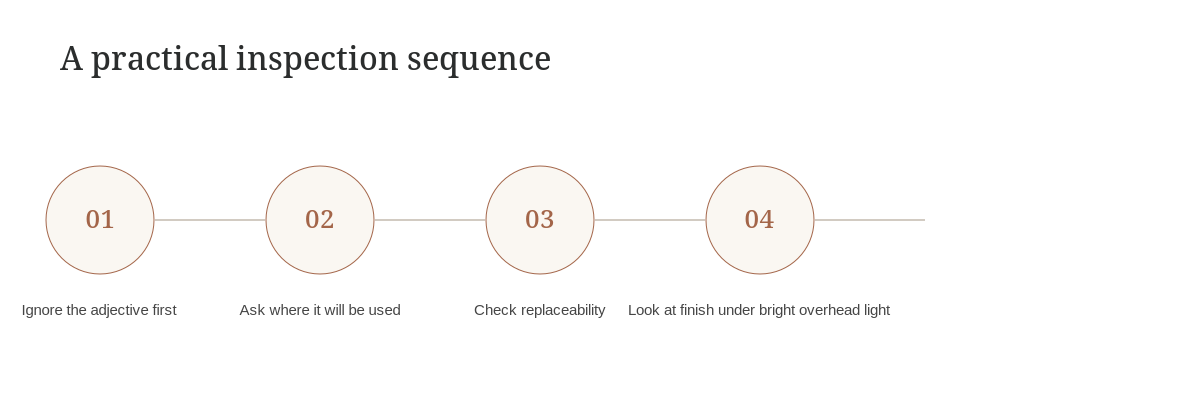
Tournament suitability is measurable. Put the largest pieces on the central squares, check board contrast under the room’s lighting, verify that the pieces stand securely, and compare the listed dimensions with the rules or event requirements that actually apply.
Find square size, king dimensions, base width and board construction.
Home practice, club nights and formal events can have different equipment expectations.
Shared sets lose pieces; a standard style is easier to replace.
Event rooms can expose glare that is less obvious at home.
What the current FIDE equipment rules actually make measurable
For non-electronic equipment effective from March 1, 2026, FIDE describes the board and pieces in physical terms. Those details are useful as a reference when a seller claims tournament suitability because they give the buyer something concrete to compare.
| Area | FIDE reference point | What a buyer can check |
|---|---|---|
| Board squares | Each square should measure 5–6 cm per side | Look for square width, not only the board’s outside dimension |
| Board appearance | Clear contrast and a matte, opaque or otherwise non-reflective finish | Check glare and square distinction under ordinary room lighting |
| Piece style | Staunton style is specified for the pieces | Look for immediately recognizable silhouettes and clear king/queen distinction |
| Piece height | The reference king height is 95 mm, with the other pieces descending in order and allowed variance under the rule | Read the actual dimensions rather than relying on “regulation size” alone |
| Stability | Pieces should remain stable and the rule includes a tilt-based stability requirement | Check weight, base, balance and whether the set topples too easily |
These are FIDE equipment specifications, not a statement that every local tournament uses the same equipment or that any product is FIDE certified. Event organizers remain the final source for what their event accepts.
Keep three different claims separate
Buyers often see “tournament,” “regulation” and “official” used as if they mean the same thing. They do not. Separating them prevents a style description from being mistaken for an approval.
Tournament-style
Usually a descriptive retail phrase. It may refer to Staunton shapes, familiar colors or common proportions, but the phrase alone does not prove event compliance.
Meets stated dimensions
A seller can provide square width, piece heights, finish and stability information that can be compared with a named rule. This is a factual, checkable statement when the measurements are accurate.
Certified or endorsed
This is a stronger claim that should be supported by the relevant organization’s process or listing. Do not infer certification from dimensions, appearance or a seller using the word “professional.”
“Tournament grade” needed a second sentence
A Stillrook note starts with a simple buyer question: “Is this tournament grade?” The listing answered with the words “professional tournament” but did not show square size, piece dimensions, stability or which organization’s rules the seller meant.
Jose’s response was to stop arguing about the adjective and list the missing measurements. That is a better way to shop. “Tournament style” can describe an appearance; event suitability depends on dimensions, finish, recognizability and the organizer’s requirements. Official certification is a separate claim again and should never be inferred from a product’s look.
Tournament equipment questions
Tournament language is useful only when it points to measurable equipment. The current FIDE equipment rules give specific board, finish and piece requirements, but a local event can still set its own equipment policy.
Current FIDE equipment reference
What should “tournament” or “FIDE-style” language actually disclose?
The listing should give measurable dimensions and the intended use instead of relying on the label. Buyers need square size, board footprint and piece dimensions so they can compare the set with the rules or equipment requirements of the event they attend.
How do I compare chess pieces that are simply labeled “weighted”?
For club or event use, skip vague weight-tier language when comparing sets. Actual piece dimensions, base size, stability and the event’s own equipment requirements are better evidence than assuming “triple weighted” is a standardized tournament category.
Are board coordinates only for beginners?
No. They can help notation, remote lessons, analysis and quick setup. Some buyers prefer a clean unmarked border for appearance, so coordinates are a use preference rather than a simple skill-level label.
Why do home, club and tournament use favor different chess equipment?
Home play may prioritize comfort and appearance; clubs emphasize durability and replacement; formal events may require specific dimensions or familiar equipment. The same set can overlap these uses, but the trade-offs should be explicit.
Is “for professionals and beginners” a meaningful product claim?
Only if the page explains why. Beginners may need coordinates and clear silhouettes, while experienced event players may prioritize standard proportions and specific board dimensions. One phrase should not erase those differences.
What matters most for chess sets used in schools, cafés or public clubs?
Replaceability, easy cleaning, durable finishes, clear silhouettes, quick inventory checks and resistance to loss usually move up the list. Premium materials can still be appropriate, but shared use changes the cost of a damaged or missing piece.