

Best Chess Sets: Find the Best Fit for How You Actually Play
Best chess set is a ranking-shaped search, but the useful answer is not one permanent winner. The best home set, gift set, travel set and shared club set can have opposite strengths. A ranking becomes more credible when the criteria are visible enough that a reader can disagree with it.
“Best” changes when the use changes
A universal ranking hides the most important tradeoffs. Start with where the set will live, who will use it and what would make it stay in the box.
Best for everyday home play
Comfortable squares, readable pieces, manageable footprint and easy storage usually matter more than exotic material.
02Best for travel
Closed size, weight, secure pieces and fast packing dominate.
03Best for beginners
Clear Staunton-like silhouettes, coordinates when useful and durable construction reduce learning friction.
04Best for club or tournament use
Measurable dimensions, stable pieces, low glare and replaceability beat vague status language.
A better way to compare chess sets at different prices
Compare the fields that create cost before comparing price: materials, dimensions, piece weight, finish, mechanism, storage, packaging and support. If the fields are missing, the price difference is not yet explained.
Fit the user first
For a gift, ask whether the recipient plays at home, travels, studies, collects or competes. Skill level alone is not enough.
Separate display value from playing value
Glass, marble and highly themed pieces can be striking but may sacrifice recognition, weight comfort, replacement availability or quiet movement.
Treat natural variation as part of the product
Wood grain and color can vary from photographs. The listing should show the expected range without reclassifying obvious defects as “natural.”
Look for evidence behind premium language
Named materials, dimensions, finish details, real product photographs, return terms and replacement support are more useful than stacked adjectives.
Include the cost of ownership
Care, storage, return shipping, replacement pieces and the risk of the set going unused all belong in a long-term value judgment.
Choose the failure you can tolerate
A travel set may compromise comfort; a display set may compromise portability; a tournament set may compromise decorative uniqueness. The best choice makes the right compromise explicit.
Price is only comparable after specifications are comparable
Two products can both say handmade, wooden and magnetic while differing in actual materials, board dimensions, piece weight, magnet structure, storage and after-sales support. Without those fields, the price difference has no stable interpretation.
A “best” list should show its losers too
If a compact set wins for travel, the same compactness may make it worse for long analysis. If a high-gloss display set wins for presentation, glare may make it worse beneath strong overhead light. Trade-offs are not flaws in the ranking; they are the evidence that the ranking is real.
Long-term value includes the chance the set is used
Replacement pieces, cleaning effort, return difficulty and everyday friction matter. Jose’s moving-box story is a useful filter: the board that earned space in the box was not necessarily the most expensive; it was the one that continued to fit daily life.
Use a short list of failures instead of a universal ranking
Best chess set, best chess board, best wooden chess set, best travel chess set and best magnetic chess set are not one product query wearing different adjectives. Each shifts the failure that matters most: footprint, wood construction, portability, magnet feel or complete-set fit. This guide owns the comparison method rather than trying to make every specialized page compete for the word “best.”
A high price does not fill missing specifications. If two products both say handmade, wooden and magnetic while omitting square size, weight, construction and support, the price gap is not yet an evidence-backed quality gap. Value becomes comparable only after the important fields become comparable. Long-term value also includes what happens after the first photograph: whether a lost pawn can be replaced, whether the storage still works after a season, whether a finish can be cared for without guesswork and whether the return window gives a gift recipient enough time to inspect the set. A board that is used every week can be a better purchase than a more dramatic one that stays in its case.
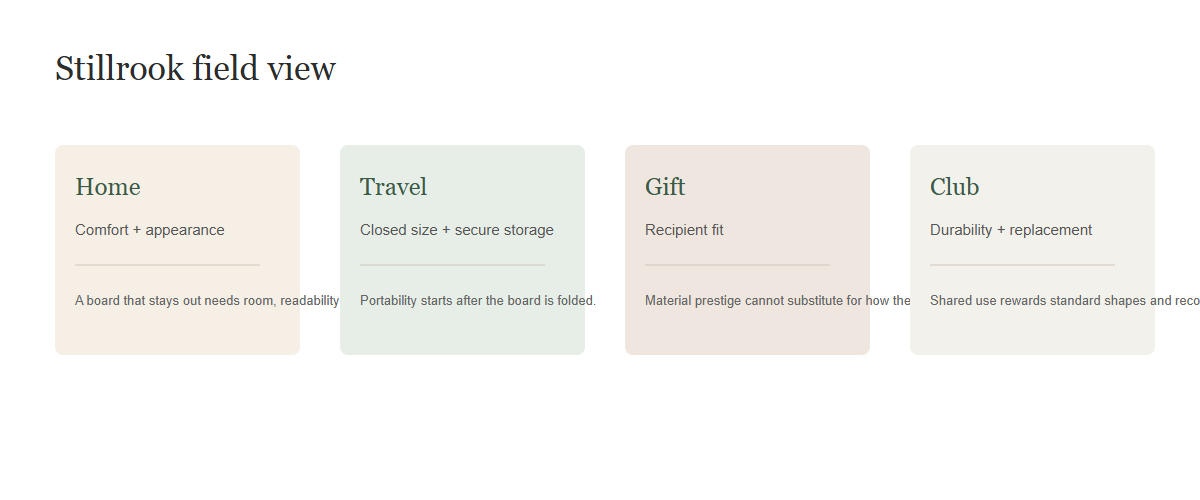
Use a scenario matrix instead of a universal ranking
One product cannot maximize portability, full-size comfort, furniture-like appearance, low price and school-level durability at the same time. A useful shortlist names the tradeoff openly.
| Use case | Prioritize | Acceptable compromise | Warning sign |
|---|---|---|---|
| Everyday home play | Readable squares, comfortable piece fit, manageable footprint, easy storage | Moderate weight and simpler packaging | A beautiful set that is too large or delicate to leave within reach |
| Travel | Closed dimensions, weight, secure pieces, fast reset | Smaller playing field | A set marketed as portable without closed thickness or weight |
| Beginner | Clear Staunton-like silhouettes, coordinates when useful, enough hand room | Less expensive material | Decorative shapes that slow piece recognition |
| Club/tournament-style play | Known dimensions, matte visibility, stable pieces, replaceability | Less furniture-like appearance | “Official” language with no stated standard or measurements |
| Gift/display | Recipient preference, finish, presentation, return timing | Some added setup or care | Buying by material prestige without knowing whether the recipient plays often |
Compare the failure you can live with
Instead of asking which set has the most features, ask what would make you stop using it. This turns vague “best” language into a practical elimination test.
Too large
A full-size board can feel excellent but become a permanent obstacle on a shared table. If setup space is the limiting factor, a slightly smaller board may deliver more actual games.
Too small
A pocket set travels beautifully but can be tiring for long home games. If it is the only set you plan to own, finger clearance deserves more weight than bag space.
Too precious
A high-gloss or delicate set can create hesitation around food, children or frequent handling. Display value is real, but only if that is the intended use.
Too specialized
Very strong magnets, unusual theme pieces or integrated electronics can solve one problem while limiting ordinary use. Pay for the specialization only when the scenario requires it.
Too vague
If dimensions, materials, weight or after-sale support are missing, a low price and a high price are both hard to evaluate. Missing facts are part of the risk.
Too hard to keep complete
Replacement availability and storage rarely appear in beauty shots, yet they determine whether a lost pawn turns an entire set into shelf décor.
Only one board survived the moving-box cut
A Stillrook note describes packing for a move when several chess sets could not all make the cut. The one that stayed was not the most expensive. It was the set that fit an ordinary table, had pieces everyone recognized, stored completely and was still the one people actually chose when they wanted to play.
That is a useful definition of long-term value. A set earns value by surviving ordinary life: it is easy to store, easy to replace, comfortable to use and attractive enough to invite another game. Price matters, but only after those practical outcomes are compared.
Questions that change the “best” recommendation
There is no useful universal “best” without a use case. A home set, travel set, learning set and club set should be allowed to win for different reasons.
What matters most when buying a chess set as a gift?
A “best” choice only makes sense after the dominant use is named. A set that earns its place on a living-room table can reasonably prioritize presence and finish; a weekly club set should put recognition, size and durability first; a travel set must justify every gram and millimeter it adds.
Why might a frequent player prefer wood or plastic over a glass, marble or highly decorative chess set?
Decorative materials can introduce glare, sliding, weight, fragile edges or unfamiliar piece shapes. Those qualities may be excellent for display and less convenient for frequent play. The right gift depends on whether the recipient wants an object to admire, a set to use often, or both.
What should a gift selector ask when I only know the budget and the recipient’s level?
Useful questions include where the set will live, whether it must travel, whether the recipient already owns pieces or a board, preference for coordinates, desired material and whether return flexibility matters more than personalization.
How should natural wood variation be presented on a gift-quality chess set?
Use representative photos and explain the expected range of grain and tone before purchase. Natural variation is different from lifted veneer, cracks, open glue lines or finish defects. A good page helps the buyer distinguish character from damage instead of using “unique grain” to dismiss every difference.
How can a product page set realistic expectations for chess-board color?
Show the board under more than one lighting condition when possible and avoid treating screen color as exact. Warm indoor light, daylight, monitor settings and glossy finish all affect appearance. Material names should describe construction, not promise one fixed shade.
What should gift packaging protect on a chess set besides the outside box?
For a gift-oriented or display set, packaging deserves its own inspection. The king crown and knight profile should not carry the load of the closed case, finished faces should not rub against hardware, and the pieces should return to obvious positions so the presentation survives more than the first unboxing.
Which “collector” extras actually add long-term value to a chess set?
Documentation is most useful when it can be checked later: material description, maker or batch identification, dimensions, care information and a credible replacement or service path. A decorative certificate with no connection to the actual set adds less practical value.
What should happen if incorrect listed dimensions make a chess board unusable on the buyer’s table?
The issue should be treated as a description accuracy problem rather than a change-of-mind fit problem. The store’s published return policy should explain how verified listing errors are handled, including shipping responsibility, instead of leaving the decision to ad hoc support.
How should returns distinguish natural wood variation, minor color difference and visible workmanship defects?
Define those categories before purchase. Expected grain variation or screen-to-room color shift should be shown with examples; open glue lines, lifted veneer, cracks or misaligned construction are different observations. Customization adds another separate return condition and should not be mixed into the material-variation rule.
How should a high-value chess set be repacked if the original packaging is gone?
Immobilize the board, protect all corners, wrap pieces individually or place them in compartments, keep hard surfaces from rubbing and use a strong outer carton with cushioning on every side. Photograph the packed condition before shipment and follow any carrier or seller requirements for high-value returns.