

Travel Chess Sets: Pack Small Without Making Play Miserable
Travel chess set is a portability promise, but portability has at least two dimensions: the volume it occupies in a bag and the room it gives adult hands during play. The smallest board can be easiest to carry and hardest to use for a forty-minute game.
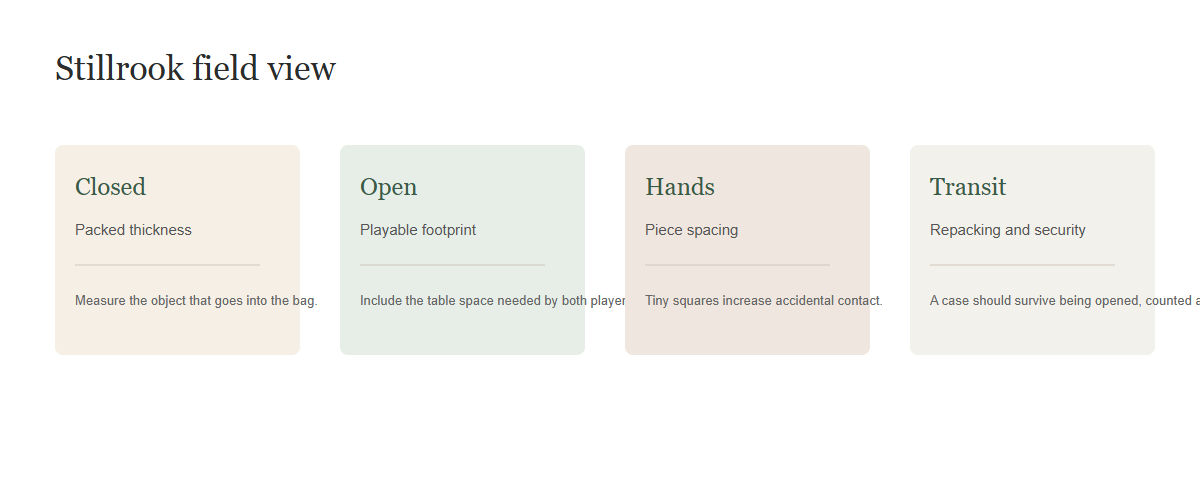
A travel set has two sizes: packed and playable
The smallest closed box is not automatically the best travel board. Portability only helps if the open board is still comfortable enough to use at the destination.
Backpack
Closed thickness, weight, snag-free edges and secure closure determine whether the set really earns space in a bag.
Hotel or café table
Open footprint matters more than product photos; leave room for drinks, phones and captured pieces.
03Car, train or boat
Magnetic retention can help, but vibration and sudden bumps are different from a static tilt test.
Outdoor play
Wind, moisture, glare and uneven surfaces can change the preferred material and piece retention method.
The set has one size in the bag and another on the table
Travel chess set, portable chess set, travel chess board and pocket chess set describe related but not identical compromises. Closed thickness and weight decide whether the set earns a place in luggage; open footprint, square size and magnet resistance decide whether adults actually enjoy moving the pieces. A mini chess set can win the first test and lose the second. The most useful travel comparison therefore records both states instead of treating “compact” as a single number.
A travel photograph usually shows the board on an empty surface. Real travel tables are not empty: a hotel lamp, train lip, cup, phone or tray can remove the exact inches a board needs. Security checks and hurried repacking add another constraint. Storage that makes every piece countable may matter more than a soft pouch that saves a few millimeters.
How small is too small for a travel chess set?
There is no single cutoff that works for every hand. The useful test is whether fingers can pick up and replace the largest and most crowded pieces without disturbing neighbors.
Measure the open squares
Do not infer playable size from the closed case. A compact case can still open to a comfortable board—or not.
Use a crowded-position test
Place several major pieces close together in the center and make normal moves. If fingertips repeatedly knock adjacent pieces, the board is too tight for that user.
Record closed thickness as well as length
A thick folding case can consume more backpack volume than a longer, flatter board.
Test interruptions
A good travel design survives being closed mid-trip, carried vertically and reopened without pieces scattering or the position becoming impossible to reconstruct.
Match stability to the transport mode
A board that passes a gentle tilt on a table may still fail under road vibration. Treat transport conditions as separate tests.
Pack it, open it, play it, pack it again
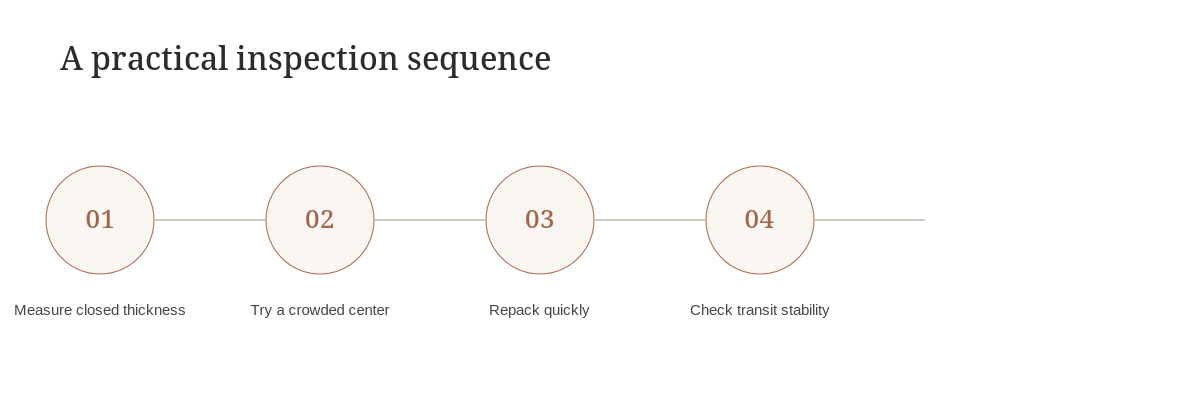
Travel fit has to survive a full cycle: pack the set into the bag you actually carry, open it on a realistically crowded surface, play a dense position, then repack it without losing track of pieces. That cycle reveals more than a single “portable” dimension.
Do not compare travel sets only by open board width.
If possible, arrange six to eight pieces in the central squares and make several moves.
Time how long it takes to put every piece back in the correct place.
If the set is magnetic, compare the weakest pieces rather than only the king.
Write down two size records: closed for transport, open for play
Travel listings often lead with the open board size because that number looks familiar. The number that decides whether the set fits a backpack is the closed package, including thickness, closure hardware and any external pouch.
| Dimension | What it predicts | Easy mistake |
|---|---|---|
| Open square width | Finger clearance and readability in a crowded position | Choosing by overall inches while the border consumes much of the playing field |
| Open footprint | Whether the board fits a hotel, café or tray table | Assuming all of the tabletop shown in a photo is actually available |
| Closed length × width | Whether it fits the bag pocket or suitcase layer you intend to use | Comparing only one closed dimension |
| Closed thickness and weight | How much space and carrying burden the set adds | Treating a thick wooden case like a flat board because both are “12 inch” products |
Small enough to carry is not always large enough to play
Very small pocket sets are excellent for short analysis, waiting rooms or a few moves in transit. They become less comfortable when adult fingers must reach into a dense middlegame or when the game continues for an hour. The useful threshold depends on hand size and play duration, so a simple crowding test is more informative than a universal minimum.
Make a paper square test
Draw or print four adjacent squares at the listed square size. Place coins or objects approximating the piece bases and practice lifting the center object without touching its neighbors. This does not reproduce the whole set, but it quickly exposes hand-clearance problems.
Match stability to the trip
A set used on a hotel desk may need no magnets at all. A train table benefits from moderate retention. A moving vehicle creates interruptions that a simple tilt test does not fully reproduce. Choose the mechanism for the expected disturbance rather than for the strongest possible demonstration.
Design the trip around the smallest realistic table, not the largest one
A travel set usually fails in context, not in a product photograph. The board may fit an empty desk but become awkward after a laptop, lamp, tray lip or cup takes part of the surface. Before buying, define the smallest table you genuinely expect to use and reserve a narrow strip beside the board for captured pieces.
Build a usable-table envelope
Measure a realistic rectangle on a desk, tray or café table and subtract the objects that cannot be moved. Compare the board’s open outside dimension with that remaining rectangle, not with the furniture’s full advertised size. If the border is wide, also compare the eight-square playing field so you know how much of the footprint is actually playable.
Plan where captured pieces go
A board that fits edge-to-edge can still be frustrating because captured pieces begin competing with drinks, phones or notation. For very small tables, a shallow tray, a dedicated side of the case or a predictable space inside the open set can be more useful than another decorative inch of border.
Practice interruption recovery
Travel games are often paused. Close the set at a believable point, carry it a short distance and reopen it. If the design is meant to preserve positions, confirm that it actually does. If it is not, judge how quickly every piece can be counted and returned to storage without relying on a photograph.
Choose the retention method for the disturbance you expect
“Travel” does not automatically mean “magnetic.” A hotel-room set mainly needs compact storage and comfortable squares. A train table may benefit from moderate magnetic retention. A pocket set used for analysis may instead prioritize a thin package and clearly readable pieces.
When magnets are present, the useful question is whether every piece can be moved naturally while the weakest piece still resists the bumps you expect. Strong attraction can make a tiny board harder to use because fingertips have less room to lift pieces cleanly. Folding cases add a different compromise: they may protect the contents and halve one packed dimension, but the hinge, center seam and closed thickness become part of the purchase. Separate these mechanisms instead of treating “travel,” “magnetic” and “folding” as synonyms.
The hotel table was smaller than the photograph
A Stillrook travel note describes a 14-inch set carried to a hotel. The table looked generous in the room photographs, but a lamp, telephone and coffee machine consumed most of the usable surface. The board had to sit at an angle, leaving little room for captured pieces.
That situation is why a travel set should be chosen for the worst realistic space, not the ideal one. Closed thickness and quick packing matter in the bag; open square size and hand clearance matter during play. A board can be “portable” in one sense and awkward in the other.
Travel chess questions for real trips
Travel changes the definition of “fit.” The set must fit a bag when closed, a real table when open and adult hands when the position becomes crowded. These questions separate those three constraints.
Magnet safety reference
How small can a travel board get before adult hands feel cramped?
There is no universal cutoff because hand size, piece shape and game length differ. The useful test is a crowded center: place several pieces on neighboring squares and make normal moves. If fingers repeatedly touch adjacent pieces, portability has started to cost playability.
What should I check before taking a travel chess set through airports, cars or camping trips?
Check closed dimensions, total weight, how pieces are retained, whether any magnets or weights can become loose, and how quickly the inventory can be counted after the case is opened. Travel exposes the set to repeated repacking, vibration and environmental changes.
Is a tilt test enough to judge a travel magnetic chess set?
No. A slow tilt checks sliding resistance, but travel also includes bumps and vibration. Compare several pieces under the same gentle tilt, then test normal pick-up and a light table nudge. The weakest piece and the most awkward lift are more informative than one dramatic angle.
Which measurements matter when a folding set is carried in a bag?
For air or rail travel, record the closed length, width and thickness as a three-dimensional package, not just a headline board size. Then shake or carry the closed set gently in the orientation it will experience in a bag and check whether the piece layout remains countable when it is reopened.
What changes when a chess set is used outdoors?
Wind, uneven surfaces, direct sun, moisture and carrying weight all matter. Magnetic stability can help, but wood and fine finishes may require more protection. There is no single material that wins every outdoor condition.