
Chess Boards: Size, Fit, Materials & Everyday Play
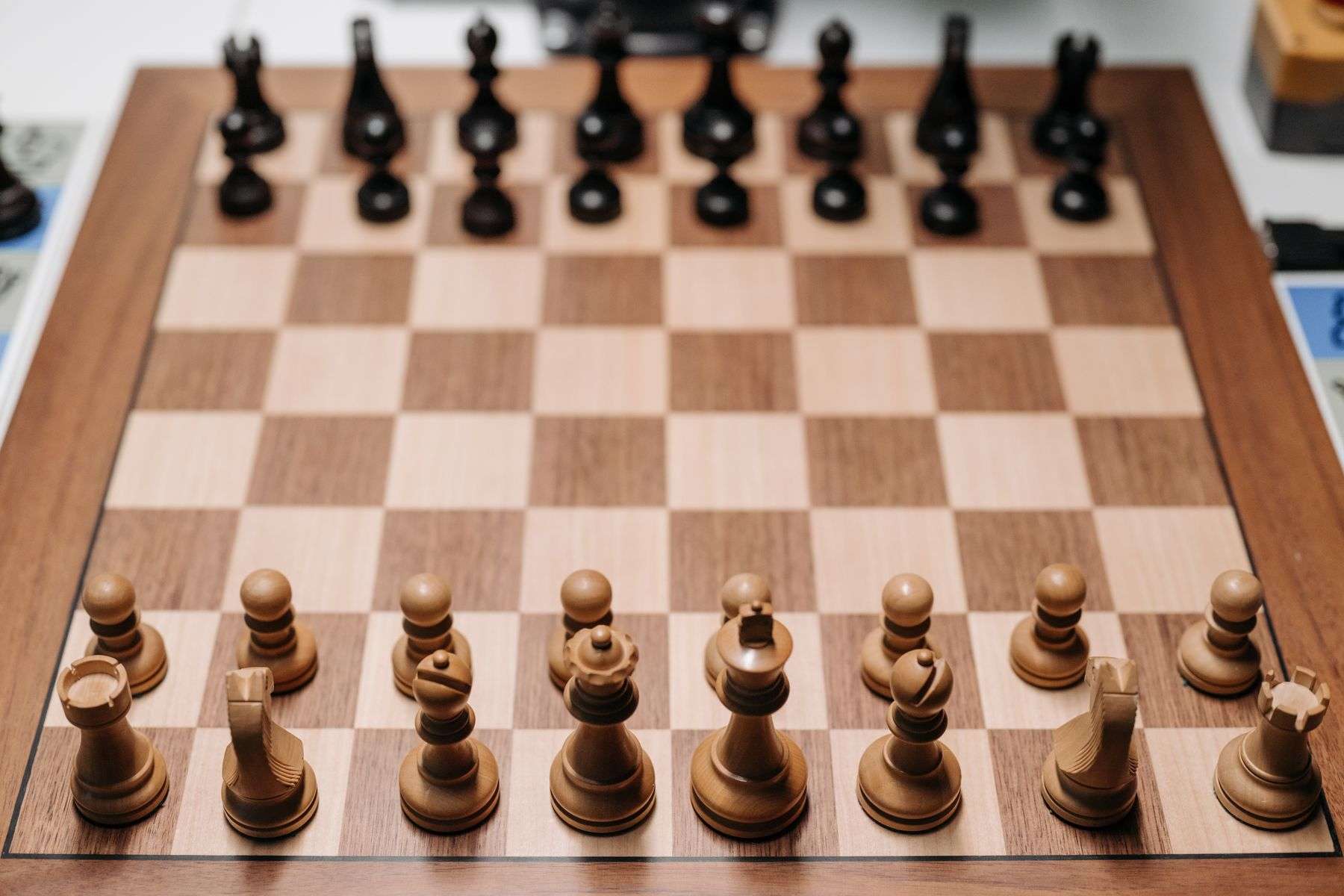
A chess board occupies more than sixty-four squares. The border takes space, the pieces need room to breathe, the light changes contrast, and the table still has to belong to the people sitting around it. A useful comparison treats the board as a physical object before it treats it as décor.
Read the footprint before the finish
People searching for a chessboard, modern chess board or simply a chess board for sale are often comparing objects that use the same category name while occupying very different amounts of furniture. The useful first split is between playing field and total footprint. A wall board, coffee-table board, analysis board and ordinary two-player board may all contain sixty-four squares, but they ask different things of reach, storage and viewing angle.
The broadest mistake is treating “board size” as if every maker measures the same edge. Borders, coordinates, drawers and frames can add inches without changing a single square. A second mistake is choosing the board before checking the pieces. Existing king bases can reverse the decision: once the pieces are fixed, square width becomes a fit problem rather than a style preference.
Start with the board you will actually live with
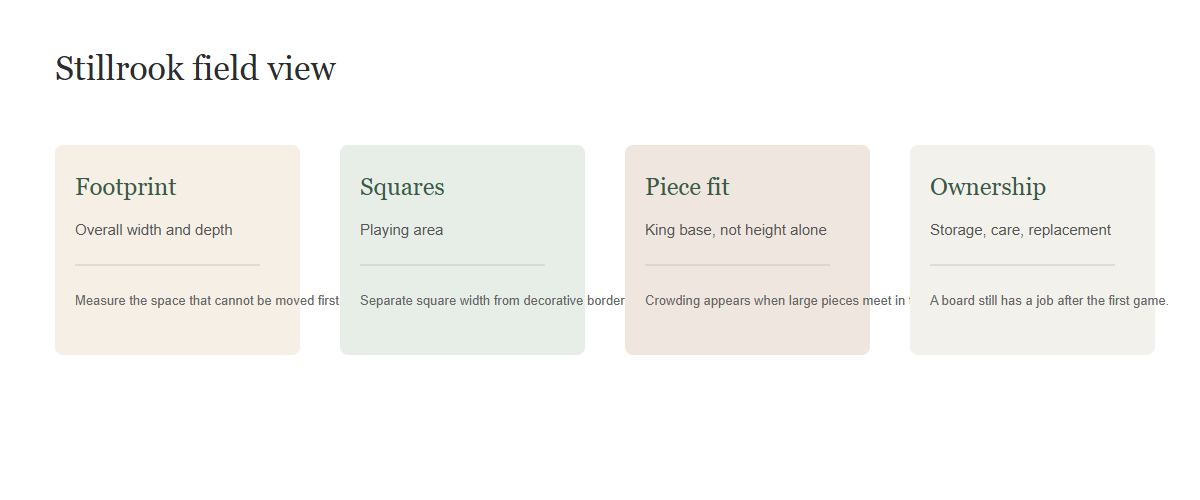
A board can be beautiful and still be the wrong physical object for the room. Start with the constraint you cannot change, then narrow the finish and style.
Table space
Measure the full footprint, including border, coordinates and any clearance needed around the board.
02Pieces you already own
Use king-base diameter and square width together. King height alone cannot tell you whether the center of the board will feel crowded.
03Material and finish
Wood species, construction and surface finish change stability, glare, care and repairability.
04Where it moves
If the board will travel, fold or hold pieces in place, portability and mechanism become part of playability.
Five checks that make chess boards comparable
The useful numbers are the ones that change fit, reach and play. If a listing omits them, the missing information matters more than the adjective used in the title.
Separate outside size from playing area
Record the overall width and depth, then the square width. A wide border can add several inches without giving the pieces any more room.
Match the king base to the square
For an existing piece set, measure the widest base. A practical fit check is whether opposing large pieces still have finger clearance when they meet near the center.
Check the room under real light
Dark-on-dark combinations and glossy finishes can lose readability under warm ceiling lights even when studio photographs look crisp.
Plan for captured pieces and accessories
A clock, notation sheet, captured pieces and two sets of hands all compete for the same table edge.
Treat conflicting measurements as unresolved
If the title, diagram and specification table disagree, do not guess which number is correct; the difference can change furniture fit and storage.
The border is part of the purchase
A 20-inch label can describe the outside of the product, the playing field, or a variant family unless the page makes the measurement explicit. For a board with coordinates, a wide frame or drawers, the difference is large enough to change whether it fits a desk.
A good contrast survives the room
Dark wood against dark pieces can look clean in a studio and become tiring under warm light. Gloss can add another layer of ambiguity. The useful test is not whether a board photographs beautifully but whether the squares and silhouettes stay easy to read from both seats.
The listing should admit what it cannot know
Words such as professional, heirloom or premium do not replace dimensions, construction, finish and support. A price comparison becomes weak when those fields are missing. A useful comparison therefore gives the buyer comparable facts before aesthetic language.
Four measurements describe a board better than one advertised size
“15 inch,” “17 inch” or “20 inch” can be useful only after the listing explains what the number measures. A buying decision becomes much more reliable when the playing field, border and furniture footprint are separated instead of compressed into one label.
Playing-field width
Multiply the square width by eight. This is the part of the board that determines how much room the position receives. It does not include a decorative border, printed coordinates outside the squares, a drawer face or a frame.
If you already own pieces, this is the dimension that should be compared with the king base. Two boards with the same outside width can have noticeably different playing fields when one has a wide frame.
Total footprint
Measure edge to edge in both directions, including fixed trim. Then add the space the board needs in use: room for wrists, captured pieces, a clock, a scoresheet or a drink placed safely away from the finish.
For a wall board or coffee-table board, the same idea applies differently. The question is reach and viewing distance rather than dining-table clearance.
Square-to-piece relationship
King height is easy to advertise, but the base diameter controls crowding. A common consumer sizing heuristic keeps the king base at roughly three quarters to four fifths of a square, then checks the queen and king side by side in a crowded center. Treat that ratio as a starting point, not a universal law.
Storage dimensions
Rigid boards need a shelf, case or permanent surface. Folding boards need a closed length, width and thickness. Boards with drawers also need clearance for the drawer to open. A product that fits the table but not the cabinet is still the wrong physical fit.
Use the room to break ties between two good boards
Once the measurements work, the remaining differences are often environmental. A board can be comfortable in one room and irritating in another because finish, contrast and surrounding furniture change what the eye and hands experience.
| What you notice | What may be causing it | What to compare before buying |
|---|---|---|
| Pieces look crowded in the center | Squares are small relative to the widest bases | Square width, king base diameter and a photographed or measured center position |
| The dark army disappears at night | Low contrast between dark pieces, dark squares and warm lighting | Finish sheen, piece color and photos taken outside bright studio lighting |
| The board dominates the table | Wide border or furniture-style frame | Outside width, usable playing field and the space left around both seats |
| The board is rarely taken out | Storage or setup has more friction than expected | Weight, case location, folding time and whether accessories stay together |
The dining table was never a one-person display case
One Stillrook field note starts with a shared dining table. Jose Hernandez wanted to leave a chess board out, while the same surface still had to handle meals, writing and a vase. The larger board won the beauty test but lost the daily-use test. A folding board that took about half a minute to open was chosen because it could return to the shelf without turning the room into a permanent display.
That small compromise captures a useful way to judge chess boards: the best size is not the largest size the table can technically hold. It is the size that leaves enough room for hands, captured pieces and the other people who use the table, while still making the position easy to read.
Hands-on checks for chess boards
Board dimensions only become useful when they predict the playing field you will actually touch. Measure the square, the border and the full footprint separately, then confirm that the board stays flat on the table you intend to use.
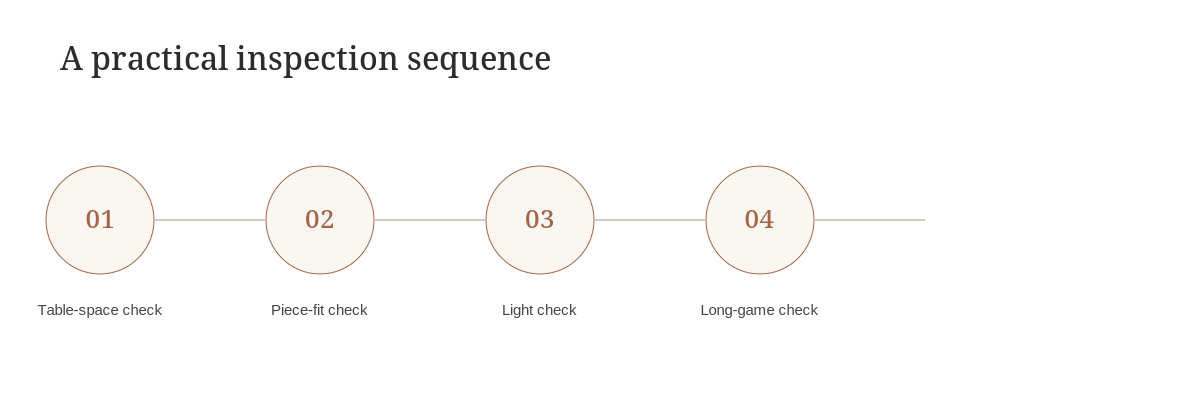
Mark the board footprint with paper or painter’s tape, then sit in both seats with the objects that normally remain on the table.
If you already own pieces, measure the king base and compare it with the square rather than using king height as the only guide.
Look at the board under the light used for evening play, not only daylight.
Leave room for captured pieces, a clock or notebook if those are part of your normal games.
Questions to answer before choosing a board
A board becomes easier to compare when every answer points back to a physical check: square width, total footprint, piece base, surface contrast or storage space.
How can I tell whether my pieces will feel crowded if a listing gives only the outside board size?
For a board-only purchase, begin with the square width rather than the outside edge. Then compare that square with the base of the king and other broad pieces. A generous frame can make a board look large on a product page while leaving a much smaller playing field than another board with the same overall footprint.
When a board has a border, coordinates or drawers, what does the advertised size mean?
For a standalone board, ask whether the quoted dimension is the 8×8 playing field or the complete outside edge. If the board includes a wide frame, raised border or integrated storage, measure that extra structure separately because it changes table fit without enlarging the squares.
What do online-only players often underestimate when buying a first physical board?
Online play hides physical constraints that a board introduces immediately: the border occupies real table area, broad pieces can crowd the center, glossy squares can reflect overhead light, and captured pieces need somewhere to sit. Those details deserve a place in the board decision before material or decoration.
Can I compare price when material, square size, weight and warranty are missing?
Only weakly. Price comparison becomes meaningful after the products disclose enough of the same fields. Otherwise the cheaper and more expensive items may not be comparable products at all.
Why do conflicting titles, filters and specifications hurt trust?
They make buyers unsure which fact controls the order and increase support and return friction. A product should have one source of truth for dimensions, material and variant details across the page.